I really liked the Monk and baby story that Alex told us about last class, so I decided to do some research. (Thank you Google!) I found a link that shares the story in more detail. The monk's name was Hakuin. At the end of the story, when the Monk is allowed back into the order, he replies, “Is that so?” Hakuin's three words reflects "acceptance of what the moment brings." Acceptance. That's what I need more in my life, and I think others would say the same. This story teaches a simple life lesson of accepting events for what they are and for people to be able to own their responsibilities.
http://workingwithinsight.wordpress.com/2007/04/12/the-monk-hakuin-and-the-baby—just-the-way-it-is/I just couldn't resist:


Thank you for finding and clarifying the story! (there are many versions of it, and in the one I heard, he shrugged. Or maybe I just didn't remember it correctly. When your memory goes....)
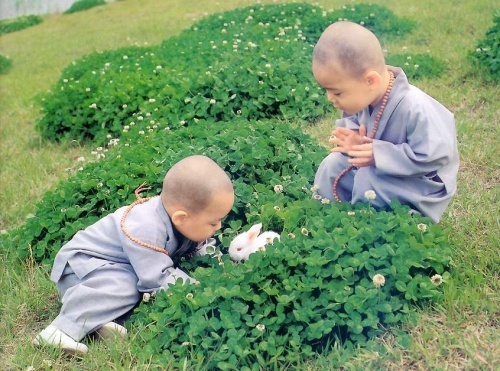
ReplyDeleteI like the pictures of the baby monks! In some Buddhist countries, such as Thailand, all young boys are required by custom to spend some time as monks, which is thought to mature their personalities and to earn them good karma.
I never knew that young boys in Buddhist countries were allowed to practice the ways of the monks. (Now the baby monks make even more sense- guess it's not just a cute photo op.) Can young girls spend time as nuns in the monastic order as well?
DeleteSo cute!!! ^.^
ReplyDeleteI find it interesting that young boys spend time as monks.
There is a passage, 138 in the introduction to chapters 9 and 10, the Buddha says children are exempt from karmic residue because he is still innocent and does not fully acquiesce in the action as an adult would have to (ex: hitting another child.)
I found this to be a bit contradicting to the other notion that we are born carrying all traces of karma from past lives to our current life. So wouldn't children be responsible for their karma?
Either way, I see no harm in having children spending time with monks. Teaching them how to be mature at an early age could save a lot of struggle down the road.
I guess the Buddha thinks differently about karma in children. Since children are so young, he brings up the point that they wouldn't know any better if an act they committed was right or wrong; they are innocent little creatures. Children have always come with the quality that they are pure and do not know any better if they hit or hurt someone. That is why I think the children practice of monks is a good thing, because maturity and understanding of proper behavior can be received at an earlier age.
ReplyDeleteThe practice of boys spending time as monks is very culturally-based; also, it appears to be dependent on an assumption of what I like to call the "banking theory of karma" - the folk idea that you want to earn as much good karma as you can, so that you'll have good luck and wind up in a useful rebirth down the road. Obviously, this contradicts some of the finer points of Buddhist theology, but if you're a subsistence-level farmer, you want every edge you can get.
ReplyDeleteGirls aren't required to spend time as nuns in most nations, and nuns are generally less respected than monks. In some countries and traditions, there are no official nuns - the line of ordination has died out. Still, some women take "nun-like" vows in order to live out religious inclinations or for other personal reasons.