Saturday, April 28, 2012

Prayer Bump


           While researching about the "72 Virgins concept," I came across another raisin idea:  a prayer bump. A prayer bump is a mark that appears on a Muslim's forehead. The bump or scar, also known as zabiba, zebiba, or zebibah ("raisin" in Arabic) can appear because Muslims pray five times a day and kneel/ touch the ground and prayer mat repeatedly during their prayer sessions. (I experienced this ritual when I went to a mosque recently.) Muslims believe the bump to be a sign of religious dedication, and some also believe that a white light will appear on their forehead when Judgement Day comes.

          This little piece of prayer trivia is very interesting and intriguing! This comes to show just how much more there is to all the religions and cultures that I knew nothing about. When you stop and think about it, our world truly is a fascinating place filled with so much more than the day to day doings of our college life in North Adams.

Speaking of my time in the mosque, I found an article about the prayer bump and the controversy that follows it in Egypt:

http://www.religionnewsblog.com/21700/a-prayer-bump-causes-division-amongst-muslims-in-egypt


While abroad, I did not notice any prayer bumps, but I will now be on the lookout. The fact that a Muslim's forehead touches the ground at least 34 times a day for prayer boggles me. I wonder if the bump really is an act of God or just coincidence? 


A "Raisined" Idea

Trying to solve the Raisin vs Virgin Debacle, I found some information on the subject that could help us decide the correct answer! 

http://wikiislam.net/wiki/72_Virgins#Virgins_or_Raisins.3F


"The false myth of "white raisins" originated from Christoph Luxenberg, a modern author writing under a pseudonym. His anti-Islamic claim, which has been accused of having a "Christian apologetic agenda", is that the Qur'an was drawn and that the Aramaic word 'hur' (white raisin) had been mistranslated by later Arab commentators into the Arabic word 'houri' (virgin)."


"Raisins, which are dried grapes, cannot have large eyes, big breasts, cannot restrain their glances, cannot be described as chaste, or have any of the characteristics listed above. The Qur'an further states that men will be wed to these houri. Men cannot be married to raisins or white grapes. Additionally, for someone to accept this "72 raisins" theory, they would also have to accept that the Qur'an was not written by Allah or revealed to Muhammad in Arabic during the 7th century, but was in fact written by Christian evangelists in Syro-Aramaic during the 8th century."


So according to Wikipedia, the raisins theory is a myth. What do you think? 


'Hur' vs 'Houri'- They both look and sound similar!

Protected Love


      Our discussion in class about women and their protectors in Ancient Arabia intrigued me. Why does it always seem to be that women appear vulnerable and lost without a man? I recently watched a movie called Sabha: A Love Story, which is about an unhappy Muslim woman, Sabha, who still lives with her family. Her brother is the head of the house, and he basically controls her life. The family is always telling her that she needs to find a husband. Sabha feels suffocated and trapped under the "power" of her brother and her family's ways. In Muhammad's time, marriage was a tool used for power and protection. Why can't marriage just be about love? Is that too much to ask?

      With this in mind, I now realize that Sabha's brother could be seen as her protector. Like discussed in class, Arabian woman needed male protectors to prevent them from being targets of slavery and other possible dangers. In the modern day love story, Sabha's brother didn't need to protect her from slavery. However, his strict ways that appeared too harsh in Sabha's eyes were really just an act of love. He wanted what was best for his sister, even if she didn't see it as that way. In this case, and in the cases of the Arabian women in Muhammad's time, do you think it was better to have "protected love" or allow women to live without protectors?


Need a Study Break?

Need a study break from our crazy college lives and our book analysis project? Bask in the glorified sounds of these beautiful Hinduism songs:


Jaya Shiva Shankara: http://www.youtube.com/watch?v=gw8iSESXI1I


Shiv Shambho: http://www.youtube.com/watch?v=9N3ve090p2o


I came across these two songs while browsing youtube and instantly fell in love. The songs are so peaceful and calming. Even though they are Hindu songs, they reminded me of Muhammad because Muhammad was a peaceful man who wanted to upkeep peace in the world.  If Muhammad had a music playlist, I wonder if he'd have listened to songs like this!       


The artist Shivali has a whole collection of songs in her repertoire entitled The Bhajan Project. In Shiv Shambho, the meaning of the phrase Jaya Jaya Shiva Shambho, Mahadeva Shambho means "Hail to the supreme Lord, the auspicious one who brings happiness and joy, who dwells in the hearts of all!" In Jaya Shiva Shankara Shiva, Jaya means victory, Shiva means "who promises you bliss" and Shankara is the Dispeller of Doubts. In Hinduism, Shiva also means the Destroyer of Evil. 


Saturday, April 21, 2012

Koran By Heart

        Unfortunately, I was unable to attend the showing of Koran By Heart at Mass MoCa this past week.  I have been to Cairo, Egypt, and was curious to see filmmaker Greg Barker's portrayal of Egypt through his eyes. When Professor Silliman first brought up the showing in class, I thought it was going to be more of an educational video about Muslim children growing up in the Middle East. While researching on the documentary's website, I found that the documentary is about the journeys of three Muslim children as they compete in Egypt's prestigious International Holy Koran Competition.

       I was wondering if anyone went to the showing and could tell me your thoughts about the documentary. Would you have liked growing up as a Muslim? When I was in Egypt, my lifestyle was incorporated into the Muslim lifestyle. For example, I went to a mosque with an Egyptian family and experienced the specific rituals in the holy place. Before entering the mosque, I had to take off my shoes and had to be fully covered from head to toe in a long shirt and pants. I also had to cover my hair with a Hijab. (A headscarf commonly used by Muslim women.) The mosque had pillars, rugs, and a bath area where people washed their hands and feet for cleansing purposes. My favorite part of the mosque was the opened skylit area. The purpose of this area is for the followers to have a close connection with Allah. With no ceiling in the way, there is no barrier for a person's thoughts and prayers to be heard by Allah. I thought this was a very beautiful concept.

      Besides this, it was interesting to witness the extreme Muslims vs the laid-back Muslims. The family I stayed with was religious, but not extremely religious. The mother would take her children to the mosque, but the children would not go by their free will if they weren't forced to. This reminds me of my Catholic adventures when my mother would make me go to Sunday mass. Besides the laid-back Muslims, I also witnessed conservative Muslims. These Muslims included women who would not be seen in public at any time without their Hijab and proper clothing. I once commented on a picture of one of my Muslim friend's beautiful long, flowing hair. She had taken the photograph of herself inside her home. When I commented on it, she became embarrassed because she was not used to showing off her hair in public (even though she was only showing me a picture of her hair and was currently wearing a hijab at the time she showed me the picture.)

      I wonder if the Koran By Heart documentary covered any of the experiences I witnessed during my time in Egypt....


Official Koran By Heart Website:
http://www.hbo.com/documentaries/koran-by-heart/index.html

Saturday, April 14, 2012

One with Everything

In response to Professor Silliman's post Mecca Today, I think it is so unique for a religion to have a pilgrimage where thousands of people preach their faith (similar and different versions) together. I actually have a friend who is going on a pilgrimage similar to this over the summer, and she is very excited. I'm envious- does the Catholic faith even do something like this?  


An idea of what the Hajj is all about:


"Setting out in their own national dress, speaking different languages, and espousing widely varying versions of Islam, by the time they arrive at Mecca these Indonesians, Afghans, and Nigerians will, in important ways, have become one. While in the sanctified area of Mecca and its neighborhood, wearing identical garb (the men at any rate, in lengths of seamless white fabric), they will speak the same Arabic prayers, perform the same rituals, and abstain from the same chores and pleasures. For many, including large numbers of women, these five days of spiritual and social togetherness will be the most important time of their lives."


Even though Islam is different from Buddhism, the idea that these different people will become one reminded me of a fun youtube clip. In the clip,  a Buddhist monk is trying to decipher a joke from a British news reporter:
http://www.youtube.com/watch?v=xXGi0RGRj-0


Even though they are different religions, Islam and Buddhism still have the same goal: to become one with everything.

In the Supreme Shrine Article:
http://www.nybooks.com/articles/archives/2012/apr/26/supreme-shrine/

"The thing about Christians"

In The North Adams Transcript, there was an article written by John Seven about Christianity entitled "The Thing about Christians." Even though our class is covering more ground than just Christianity (Thank you Buddha), I can't seem to get the Christianity topic out of my head. Through my search into media and our conversations in Blogger, I  think that Christianity and its flaws(?) are up there for big conversation starters.

Hence, in my new blog post, Seven's article talks about his view on Catholicism. Check out the link to his Blog:

http://johnsevencollection.wordpress.com/2012/03/16/the-thing-about-christians/

Quotes from the article that I found interesting:

  • "I, and many others, would love to see a movement of non-extremist Christians, as organized and prominent in the culture as any of the conservative evangelicals, who see the core values of their faith as something really worth fighting for. I keep hearing about all the liberal Christians, but I’ve not noticed any major actions from them."
  •  If the love, tolerance and charity of Christ is in your heart, then you’d best do something about the political pirates who have hijacked your spirituality for the purposes of control, because they are the ones defining doctrine these days.
  • One thing I can say is that I am not the one who put his religious beliefs at the center of political rhetoric, and so I reserve the right to treat that religion as a central issue in my political dialogue so long as other people insist on doing the same. Christians do not get to have it both ways — they can’t push their belief as motivation for laws and then whine that anyone who touches it is out of line.

And my personal favorite:
"For the sake of argument, let’s say that I am obsessed with Christianity. The real question is why that is, not whether I am."


Huh. Interesting point. So Seven is saying that he might not necessarily be a Catholic, but he is still intrigued with the religion. I think his statement can affect everyone who is reading my post at this very moment. I think that many people are obsessed with the topic of Christianity. Don't you? 

Saturday, April 7, 2012

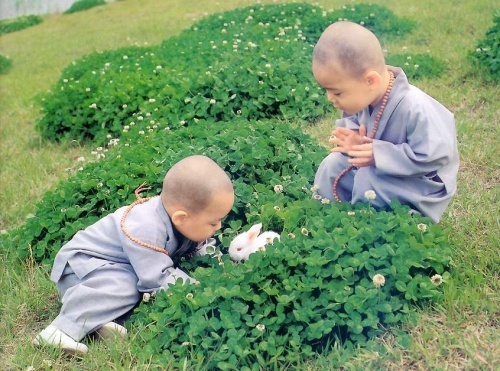
The Monk Hakuin and the Baby

I really liked the Monk and baby story that Alex told us about last class, so I decided to do some research. (Thank you Google!) I found a link that shares the story in more detail. The monk's name was Hakuin. At the end of the story, when the Monk is allowed back into the order, he replies, “Is that so?” Hakuin's three words reflects "acceptance of what the moment brings."  Acceptance. That's what I need more in my life, and I think others would say the same. This story teaches a simple life lesson of accepting events for what they are and for people to be able to own their responsibilities. 

http://workingwithinsight.wordpress.com/2007/04/12/the-monk-hakuin-and-the-baby—just-the-way-it-is/


I just couldn't resist:


MONK BABIES! TOO CUTE!!!

Do Gods make mistakes?

Do gods make mistakes?

After the realization and knowledge of determining that Buddha is not a god- He may look like a God due to his godlike glow and his task to preach Buddhism to followers, he is just a wealthy prince turned into a poor, enlightened man. He is a human being, showcasing his raw emotions and challenges over the course of his life. For example, he showed stubbornness for not allowing women into the monastic order at first, but then he willingly and quickly changed his mind. I think that his initial reaction to females in the order can be categorized as a mistake for Buddha, but then he ultimately decided that his thinking was wrong and allowed his female relatives to be the first nuns in his order!

So since the great Buddha made a mistake and he is a human, do you think actual gods are in the position to make mistakes?

The Song of the Hours


In my Dramatic Literature class, I just finished reading the play Mother Courage by Bertolt Brecht. In the play, the character, Chaplain, sings a song about the “Passion of Our Lord and Savior.” In other words, he was singing about Jesus. This reminded me of our Jesus unit. The song is called The Song of the Hours. Chaplain was inspired to sing the song because another character, Swiss Cheese, was being held captive by soldiers in The Thirty Year’s War. Chaplain inferred that such an act was common “in the history of religion.”


The Song of the Hours

In the first hour of the day
Simple Jesus Christ was
Presented as a murderer
To the heathen Pilate

Pilate found no fault in him
No cause to condemn him
So he sent the Lord away.
Let King Herod see him!

Hour the third: the Son of God
Was with scourges beaten
And they set a crown of thorns
On the head of Jesus.

And they dressed him as a king
Joked and jested at him
And the cross to die upon
He himself must carry.

Six: they stripped Lord Jesus bare.
To the cross they nailed him.
When the blood came gushing, he
Prayed and loud lamented.

Each upon the cross, two thieves
Mocked him like the others.
And the bright sun crept away
Not to see such doings.

Nine: Lord Jesus cried aloud
That he was forsaken!
In a sponge upon a ple
Vineagar was fed him.

Then the Lord gave up the ghost
And the earth did tremble.
Temple curtains split in twain.
Cliffs fell in the ocean.

Evening: they broke the bones
Of the malefactors.
Then they took a spear and pierced
The side of gentle Jesus.

And the blood and water ran
And they laughed at Jesus.
Of this simple son of man
Such and more they tell us. 

I thought this was interesting because the song retells the accounts of Jesus’ crucifixion in a clear-cut manner.  The song  goes by every hour of Jesus’ steps to the crucifixion.