In response to Professor Silliman's post Mecca Today, I think it is so unique for a religion to have a pilgrimage where thousands of people preach their faith (similar and different versions) together. I actually have a friend who is going on a pilgrimage similar to this over the summer, and she is very excited. I'm envious- does the Catholic faith even do something like this?
An idea of what the Hajj is all about:
"Setting out in their own national dress, speaking different languages, and espousing widely varying versions of Islam, by the time they arrive at Mecca these Indonesians, Afghans, and Nigerians will, in important ways, have become one. While in the sanctified area of Mecca and its neighborhood, wearing identical garb (the men at any rate, in lengths of seamless white fabric), they will speak the same Arabic prayers, perform the same rituals, and abstain from the same chores and pleasures. For many, including large numbers of women, these five days of spiritual and social togetherness will be the most important time of their lives."
Even though Islam is different from Buddhism, the idea that these different people will become one reminded me of a fun youtube clip. In the clip, a Buddhist monk is trying to decipher a joke from a British news reporter:
http://www.youtube.com/watch?v=xXGi0RGRj-0
Even though they are different religions, Islam and Buddhism still have the same goal: to become one with everything.
In the Supreme Shrine Article:
http://www.nybooks.com/articles/archives/2012/apr/26/supreme-shrine/
Saturday, April 14, 2012

"The thing about Christians"
In The North Adams Transcript, there was an article written by John Seven about Christianity entitled "The Thing about Christians." Even though our class is covering more ground than just Christianity (Thank you Buddha), I can't seem to get the Christianity topic out of my head. Through my search into media and our conversations in Blogger, I think that Christianity and its flaws(?) are up there for big conversation starters.
Hence, in my new blog post, Seven's article talks about his view on Catholicism. Check out the link to his Blog:
http://johnsevencollection.wordpress.com/2012/03/16/the-thing-about-christians/
Quotes from the article that I found interesting:
And my personal favorite:
"For the sake of argument, let’s say that I am obsessed with Christianity. The real question is why that is, not whether I am."
Huh. Interesting point. So Seven is saying that he might not necessarily be a Catholic, but he is still intrigued with the religion. I think his statement can affect everyone who is reading my post at this very moment. I think that many people are obsessed with the topic of Christianity. Don't you?
Hence, in my new blog post, Seven's article talks about his view on Catholicism. Check out the link to his Blog:
http://johnsevencollection.wordpress.com/2012/03/16/the-thing-about-christians/
Quotes from the article that I found interesting:
- "I, and many others, would love to see a movement of non-extremist Christians, as organized and prominent in the culture as any of the conservative evangelicals, who see the core values of their faith as something really worth fighting for. I keep hearing about all the liberal Christians, but I’ve not noticed any major actions from them."
- If the love, tolerance and charity of Christ is in your heart, then you’d best do something about the political pirates who have hijacked your spirituality for the purposes of control, because they are the ones defining doctrine these days.
- One thing I can say is that I am not the one who put his religious beliefs at the center of political rhetoric, and so I reserve the right to treat that religion as a central issue in my political dialogue so long as other people insist on doing the same. Christians do not get to have it both ways — they can’t push their belief as motivation for laws and then whine that anyone who touches it is out of line.
And my personal favorite:
"For the sake of argument, let’s say that I am obsessed with Christianity. The real question is why that is, not whether I am."
Huh. Interesting point. So Seven is saying that he might not necessarily be a Catholic, but he is still intrigued with the religion. I think his statement can affect everyone who is reading my post at this very moment. I think that many people are obsessed with the topic of Christianity. Don't you?
Saturday, April 7, 2012
The Monk Hakuin and the Baby
I really liked the Monk and baby story that Alex told us about last class, so I decided to do some research. (Thank you Google!) I found a link that shares the story in more detail. The monk's name was Hakuin. At the end of the story, when the Monk is allowed back into the order, he replies, “Is that so?” Hakuin's three words reflects "acceptance of what the moment brings." Acceptance. That's what I need more in my life, and I think others would say the same. This story teaches a simple life lesson of accepting events for what they are and for people to be able to own their responsibilities.
http://workingwithinsight.wordpress.com/2007/04/12/the-monk-hakuin-and-the-baby—just-the-way-it-is/I just couldn't resist:
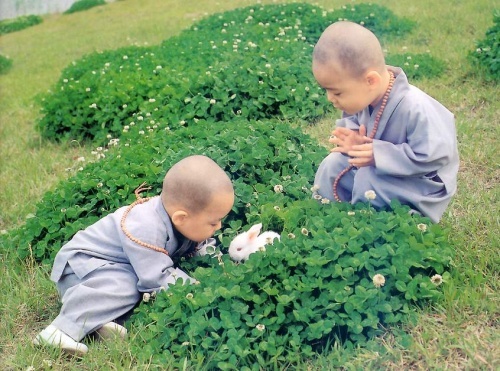

Do Gods make mistakes?
Do gods make mistakes?
After the realization and knowledge of determining that Buddha is not a god- He may look like a God due to his godlike glow and his task to preach Buddhism to followers, he is just a wealthy prince turned into a poor, enlightened man. He is a human being, showcasing his raw emotions and challenges over the course of his life. For example, he showed stubbornness for not allowing women into the monastic order at first, but then he willingly and quickly changed his mind. I think that his initial reaction to females in the order can be categorized as a mistake for Buddha, but then he ultimately decided that his thinking was wrong and allowed his female relatives to be the first nuns in his order!
So since the great Buddha made a mistake and he is a human, do you think actual gods are in the position to make mistakes?
The Song of the Hours
In my Dramatic Literature class, I just finished reading the play Mother
Courage by Bertolt Brecht. In the play, the character, Chaplain, sings a song
about the “Passion of Our Lord and Savior.” In other words, he was singing
about Jesus. This reminded me of our Jesus unit. The song is called The Song of the Hours. Chaplain was inspired to sing the song because
another character, Swiss Cheese, was being held captive by soldiers in The
Thirty Year’s War. Chaplain inferred that such an act was common “in the
history of religion.”
The Song of the Hours
In the first hour of the day
Simple Jesus Christ was
Presented as a murderer
To the heathen Pilate
Pilate found no fault in him
No cause to condemn him
So he sent the Lord away.
Let King Herod see him!
Hour the third: the Son of God
Was with scourges beaten
And they set a crown of thorns
On the head of Jesus.
And they dressed him as a king
Joked and jested at him
And the cross to die upon
He himself must carry.
Six: they stripped Lord Jesus bare.
To the cross they nailed him.
When the blood came gushing, he
Prayed and loud lamented.
Each upon the cross, two thieves
Mocked him like the others.
And the bright sun crept away
Not to see such doings.
Nine: Lord Jesus cried aloud
That he was forsaken!
In a sponge upon a ple
Vineagar was fed him.
Then the Lord gave up the ghost
And the earth did tremble.
Temple curtains split in twain.
Cliffs fell in the ocean.
Evening: they broke the bones
Of the malefactors.
Then they took a spear and pierced
The side of gentle Jesus.
And the blood and water ran
And they laughed at Jesus.
Of this simple son of man
Such and more they tell us.
I thought this was interesting
because the song retells the accounts of Jesus’ crucifixion in a clear-cut
manner. The song goes by every hour of Jesus’
steps to the crucifixion.
Saturday, March 31, 2012
Attaining Nirvana
Before Buddha becomes enlightened, he says:
"Come what may-let my body rot, let my bones be reduced to ashes-I will not get up from here until I have found the way beyond decay and death"(p 38).
I admire Buddha for his actions, for Buddha is expressing stubbornness and maturity in order to find the answer to a life without samsara. In my opinion, I think he is tired of people's addiction to samsara, the concept that the world is full of suffering. The world suffers even more because people do not want to accept change.
When Buddha becomes enlightened, he says:
"Perhaps, there will be a few who will listen. Dust does cover the eyes of all, but for some it is only a thin film. Everyone desires an end to suffering and sorrow. To those who will listen, I will teach the dharma, and for those who follow it, the dharma itself will set them free" (41).
Is Buddha trying to teach his followers the concept of Nirvana? Does he want his followers to try to achieve this difficult task? Do you think attaining Nirvana is even possible in today's society?
After all, Buddha has been charged with a "transcendent power" (42), a power that can only be experienced beyond the normal level or capabilities. He has extinguished the demon of selfish desire.
But how difficult would it be for me to extinguish selfish desire? Maybe I should start wearing an orange robe and sit under a banyan tree....
A "Godlike" Buddha
While reading the Introduction to The Dhammapada, I thought it was interesting when Siddhartha was mistaken for a God. On page 37, a beautiful woman with a newborn wanted to give thanks for her son. Her handmaid mistook Buddha for a god and exclaimed, "The radiant god for whom you prayed for a son is sitting under the banyan tree by the side of the river.Why not make your offering for him directly?"
At first I was confused, because I didn't think that Budda was a god. However, during class, Alex explained that the handmaid might have mistaken him for a god because he was giving off a radiant glow.
And it's true. In every picture I can find of Buddha, he has a yellow orb around his head. During his enlightenment, when he finally found nirvana, he was at peace with himself and shined with an inner light. He became "awake." That got me thinking. Why couldn't Buddha be a god? He reminds me of Jesus in a way, for Jesus became enlightened with new teachings and wanted to preach his word to his disciples and beyond as well. And technically speaking, Jesus is God because he is part of the Holy Trinity, which means the Father, Son, and the Holy Spirit are one and the same. So why not Buddha?
Buddha's Glow:
Subscribe to:
Posts (Atom)